Hexagonal Graph Paper
A honeycomb of regular hexagons for benzene rings, hex maps and tiling patterns, drawn without measuring anything.

A honeycomb of regular hexagons for benzene rings, hex maps and tiling patterns, drawn without measuring anything.
Choose Hexagonal Graph Paper from the list. It opens with the usual size already set.
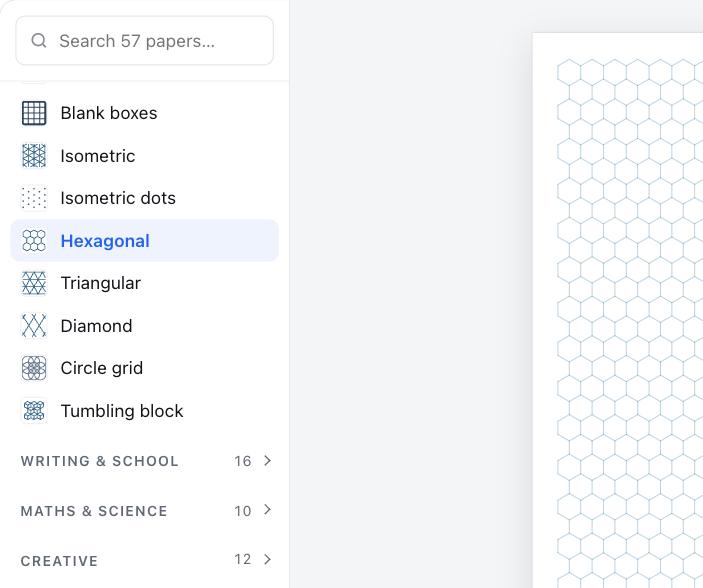
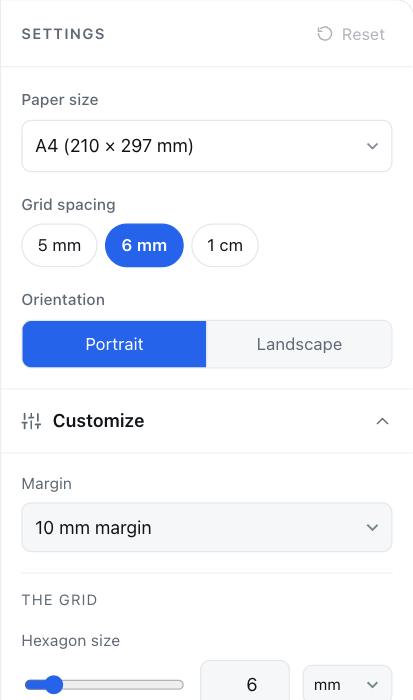
Pick the paper size, the grid and the orientation. Customize holds colours, margins and more.
Download the ready PDF, or print straight from the page at 100% scale.

The two orientations are the same tiling rotated by 30°, but they are not interchangeable in use. Pointy top hexagons stack in horizontal rows, which is what organic chemistry uses and what most hex-and-counter games expect.
Flat top hexagons stack in vertical columns. Board game maps and a lot of tile design use this one, because columns of flat-topped hexes line up neatly against a rectangular page.
For drawing structures, the hexagon size decides how much of a reaction scheme fits on one sheet.
Every sheet here is free, adjustable and prints at exact scale.
5 to 7 mm. That is large enough to write substituents inside the ring and small enough that a full reaction scheme still fits on one A4 sheet.
Pointy top, so rings sit in horizontal rows the way they are drawn in textbooks and fused ring systems line up sideways.
The size here is the circumradius — centre to a corner. Across the points is twice that; across the flats is about 1.73 times it.


